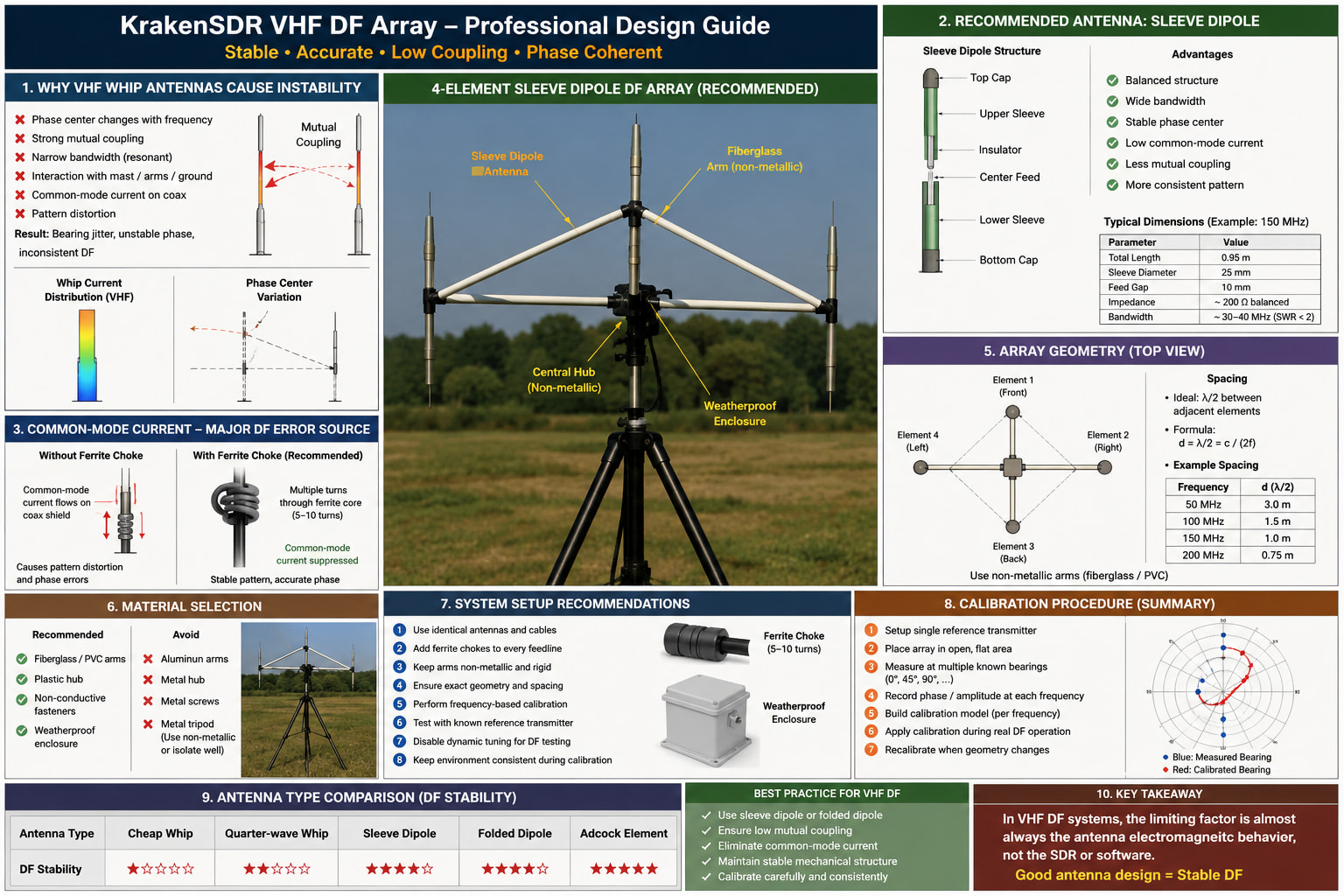
This image is a professional engineering infographic for a VHF Direction Finding (DF) antenna system, designed to explain how to build a stable and accurate KrakenSDR-style array.
 Overall Concept
The diagram explains how to build a stable VHF DF antenna array that avoids common problems like phase errors, coupling, and signal distortion.
The key idea is:
Good antenna design = stable direction finding (DF)
Not just good SDR software.
 1. Problems with VHF Whip Antennas
The left section shows why simple whip antennas are unstable for DF:
-
Phase center shifts with frequency
-
Strong mutual coupling between antennas
-
Narrowband behavior (resonance issues)
-
Interaction with mast and ground
-
Common-mode current on coax cables
 Result:
-
Unstable bearing
-
Jittery direction readings
-
Inconsistent DF results
2. Recommended Antenna: Sleeve Dipole Array
The center shows the best DF design:
 4-element sleeve dipole array
-
Mounted on fiberglass (non-metal) arms
-
Balanced radiation pattern
-
Stable phase center
Key advantage:
-
Much lower mutual coupling
-
More accurate phase measurement
-
Better DF stability than whip antennas
 3. Common-Mode Current Problem
This section shows a major hidden issue:
-
Without ferrite choke → coax cable acts like antenna

-
With ferrite choke → clean signal path
Solution:
Use ferrite chokes (multiple turns) on every feedline.
 4. Array Geometry (Top View)
This shows antenna placement:
-
4 antennas in a symmetric square or cross shape
-
Ideal spacing ≈ ½ wavelength (λ/2)
Example:
- At 150 MHz → about 1 meter spacing
Important:
-
Geometry must be perfectly symmetrical
-
Even small errors affect DF accuracy
 5. Material Selection
Good vs bad materials:
Recommended:
-
Fiberglass arms
-
Plastic or insulated mounts
-
Non-metal structure
Avoid:
-
Aluminum arms
-
Metal frames near antennas
-
Conductive support structures
 6. System Setup Recommendations
Best practices:
-
Use identical antennas and cables
-
Add ferrite chokes everywhere
-
Keep geometry fixed and rigid
-
Do frequency-based calibration
-
Disable dynamic tuning during DF tests
-
Use controlled test transmitter
 7. Calibration Procedure
Steps for accuracy:
-
Use a known transmitter signal
-
Measure from multiple angles
-
Record phase and amplitude
-
Build calibration model per frequency
-
Recalibrate when setup changes
 8. Antenna Type Comparison
Stability ranking:
-
Cheap whip →
worst -
Quarter-wave whip → low stability
-
Sleeve dipole → good
-
Folded dipole → better
-
Adcock array → best
 Key Insight (Very Important)
The bottom message of the image:
In VHF DF systems, the biggest limitation is antenna physics, not SDR software.
Final Summary
This design guide is basically saying:
-
VHF DF is not just electronics
-
It is electromagnetics + mechanical engineering
-
Stability comes from:
-
clean antenna design
-
controlled geometry
-
low coupling system
-