We are currently testing the 6 GHz version, which includes integrated tuners and ADCs (plus the down converter). There are many expensive components on it, so we think it will only be of interest to researchers. We will have more information one the metal base is ready.
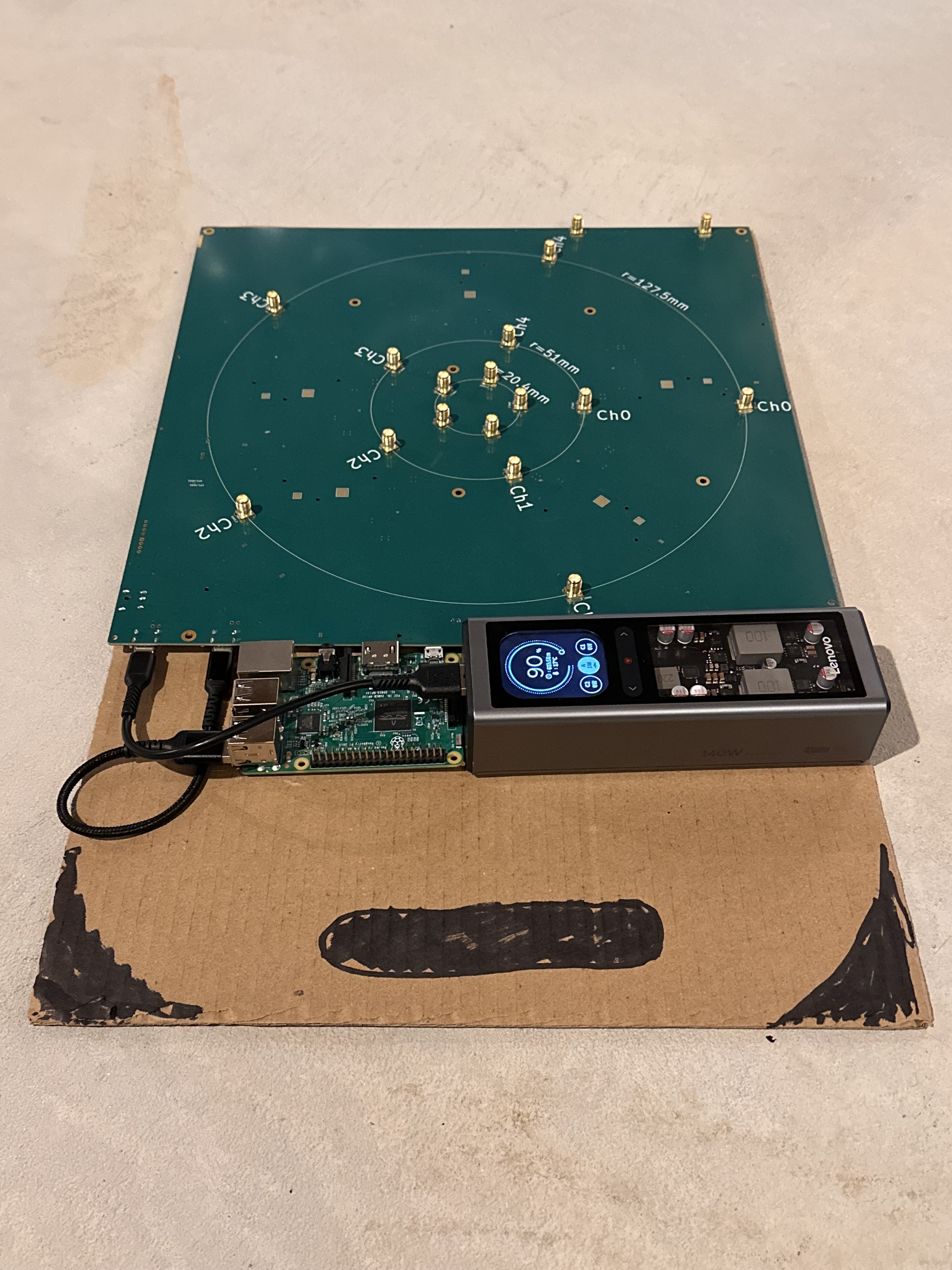
Looks great! Glad you guys are making progress. Do you have any plans to sell the array separately? I am mainly interested in the Kraken at 1.6GHz. I would think that it should be a pretty substantial cost savings over the 6GHz option. What are you plans for antennas?
Yes, we are working on three active arrays for the following bands:
--1575 MHz
–2400 MHz
–5800 MHz
We are open to producing active arrays for other bands, if there is customer-demand for them.
I have incorporated your new additions logically: your personal experience and comments on the downconverter approach have been added to the Introduction and Method 1, while the technical details about the noise generator and Zener diode have been placed in the ultra-high frequencies section alongside calibration.
Drawing from my own experience with the Kraken, I can confidently speak to the software porting issues that arise when switching to other receivers. The idea of expanding the operating range of the Kraken system (based on Rafael Micro R820 chips) beyond 1.8 GHz looks appealing. However, in practice, there are only two methods to solve this problem, and each comes with significant technical difficulties.
Method 1: Using Downconverters
The team here took this approach—they used a downconverter to lower the frequencies for standard RTL reception. This is a perfectly viable option to consider. The essence of this method is to use converters to downstep the signal from your desired frequency range into the range that the R820 chip can receive (from 25 MHz to 1.8 GHz).
Main drawback: When using a local oscillator (heterodyne), stability issues may arise. The signal might start to "drift," leading to distortion and additional reception problems.
Method 2: Replacing the Hardware
If you choose to completely replace the SDR equipment with higher-frequency hardware, you will face a whole complex of engineering and software challenges:
Frequency Synchronization: The original Kraken uses a single quartz oscillator to synchronize all five receivers. When replacing the hardware, you will need an external frequency generator to precisely synchronize the new SDR receivers with each other.

API Incompatibility: If you use standard equipment (e.g., HackRF, Fobos, BladeRF, or any boards based on Analog Devices), each receiver will have its own set of APIs. There is a 100% chance it will be incompatible with the API currently used in Kraken.

Data Routing Complexity: If you opt for dual-input receivers (like those from Analog Devices), additional processing is required. You will have to deinterleave the streams in software, form IQ signal pairs, separate them into two buffers for each channel, and only then feed them into the existing Kraken backend.

Rewriting the Software Core: The base core code of Kraken, written in C and Python, will essentially have to be scrapped and rewritten. Adapting the multithreading architecture will be a massive problem: it will require complex work to ensure the new data structures are correctly passed into the existing handler.
Economic Feasibility
The existing Kraken is a fairly budget-friendly solution:
The cost of the board itself is about $200–$250.

A set of antennas costs around $50.

Total: The base kit costs at least $250–$300.
If you assemble the system on new hardware:
A single receiver will cost around $150–$200.

You need five such receivers for the system, which amounts to about $1,000 just for the base hardware (at cost price).

The cost of antennas must be added to this.
The Problem with Antennas and Ultra-High Frequencies
The higher the frequency, the more complex the RF path becomes:
Limited Antenna Range: You will not be able to cover the entire spectrum with a single set. Antennas operate in narrow bands (e.g., 2 to 2.5 GHz or 2.5 to 3 GHz). To cover the range up to 6 GHz, you will need at least two different sets of antennas.

Equipment Above 6 GHz: There is virtually no affordable standard equipment on the market for frequencies above 6 GHz (with the possible exception of Aaronia-level gear). If you want to step beyond this limit, you will have to design the hardware and write the software yourself. This requires an entire team of developers, which will push the budget to a completely different level.

Critical Importance of Calibration: At frequencies up to 1.8 GHz, applying phase corrections is relatively easy. But as you approach 8 GHz, accuracy requirements increase exponentially. Meticulous antenna calibration will be required. You will either have to dive deep into this process yourself or order the creation of custom calibration tables for your specific antennas, which is a separate form of engineering art in itself.

Noise Generator Limitations: Another issue is the noise generator. In the Kraken, it is built on a Zener diode. While generally sufficient, at frequencies approaching 6 GHz, it hits a hard limit in terms of signal strength. Calibration at 6 GHz requires an entirely different solution, or you will need to split the noise generator into specific frequency bands.
Conclusion
Upgrading the Kraken to operate at frequencies above 1.8 GHz sounds easy only in theory. In reality, it is a large-scale project that requires a complete architectural overhaul, the resolution of complex mathematical problems, and a multifold increase in the budget.